
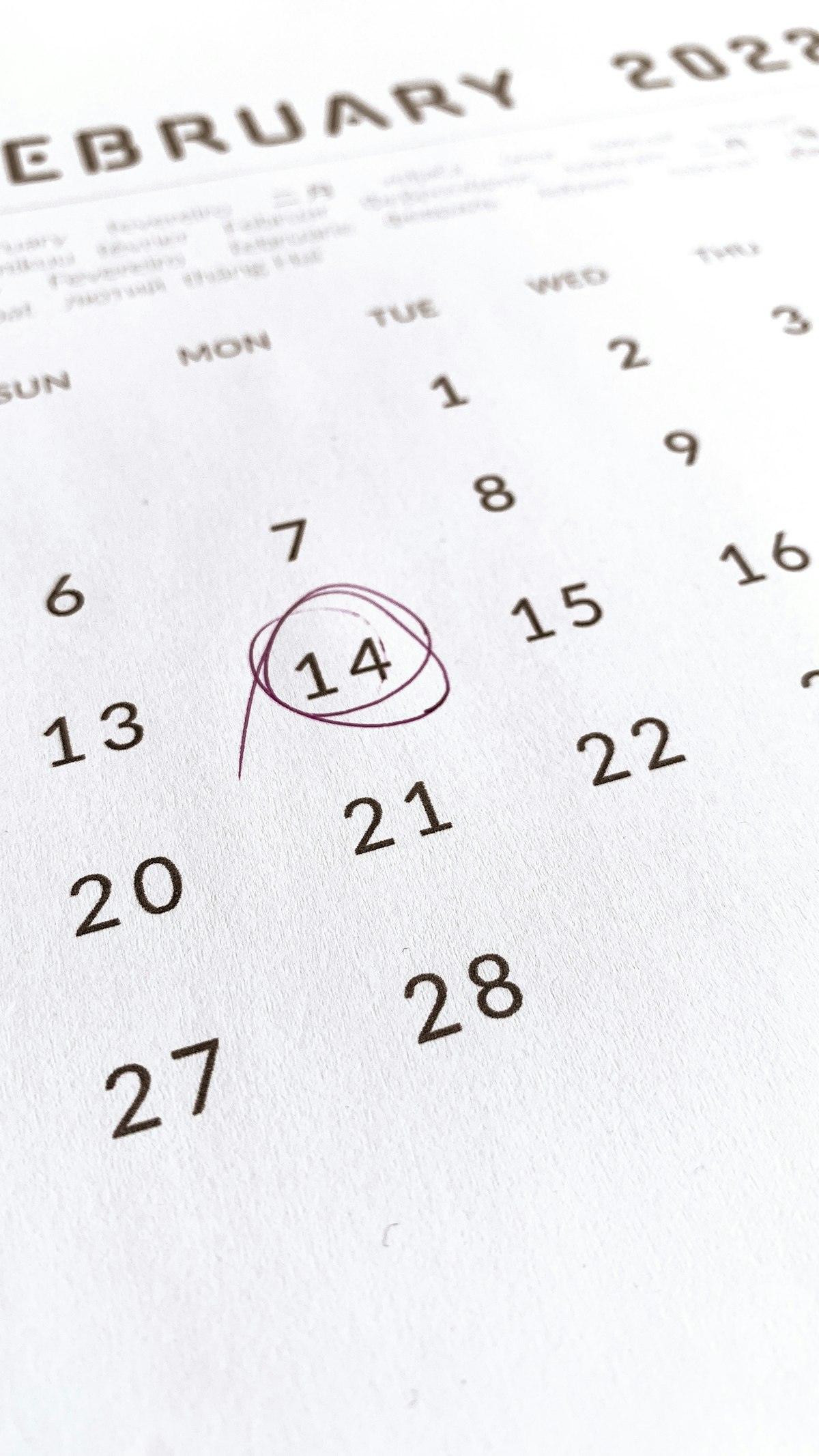
 Photo by Glen Carrie on Unsplash
English answers the question "when?" with three completely different prepositions depending on the sentence: "in 2024," "on Tuesday," "at 5 PM." There's no single master rule that covers every case in English prepositions, but there is one genuinely useful pattern for the most common ones: think of in, on, and at as a zoom lens, moving from the widest view down to one exact point — and the same zoom logic works for place, not just time.
Prepositions of time
| Preposition | Used for | Examples |
|---|---|---|
| in | longer periods — years, months, seasons, centuries, parts of the day | in 2024, in July, in summer, in the 21st century, in the morning |
| on | days and dates | on Monday, on July 4th, on my birthday, on Christmas Day |
| at | precise times, plus night | at 5 PM, at noon, at midnight, at night |
in = the widest span of time → on = a specific day → at = an exact point in time.
Prepositions of place
| Preposition | Used for | Examples |
|---|---|---|
| in | enclosed spaces, cities, countries | in London, in France, in the box, in the kitchen |
| on | surfaces, streets, public transport | on the table, on Main Street, on the bus, on the second floor |
| at | a specific point, an address, an event | at the door, at 221B Baker Street, at the bus stop, at the concert |
Same zoom logic: in = inside a larger area → on = touching a surface or line → at = one exact point.
 Photo by Jean Woloszczyk on Unsplash
The exceptions worth memorizing
- At night, alongside at noon and at midnight — these three are treated as single points on the clock, not stretches of time, unlike morning/afternoon/evening.
- On the bus/train/plane, but in the car/taxi — vehicles you can stand up and move around in take "on"; small, enclosed vehicles you sit inside take "in." See the FAQ below for why.
- At home, but in the house — "home" is treated as a point or a base rather than a physical structure.
- At work/school (the activity or institution) vs. in the office/classroom (the physical room itself).
Common mistakes
- Using "at" for a whole day or longer period.
at Monday→ on Monday.at 2024→ in 2024. - Using "in" for public transport you walk around in.
in the bus→ on the bus. - Saying "in the night" as a general statement.
I don't sleep well in the night→ I don't sleep well at night ("in the night" only works for one specific occasion: I heard a noise in the night). - Using "at" for cities or countries.
at London→ in London.
More prepositions you will need
Once in, on and at feel natural, a few other prepositions of time and place come up constantly.
Time
- for a length of time: I studied for two hours.
- since a starting point: I have lived here since 2019.
- during something that is happening: Please stay quiet during the film.
- by a deadline: Send the report by Friday. (on or before Friday)
- until / till an end point: The shop is open until 8 PM.
- before / after: Call me after lunch.
Place
- between two things, among many: The cafe is between the bank and the station. She was standing among the crowd.
- above / below (higher or lower, not touching), over / under (covering or directly beneath): The picture is above the sofa. The cat is under the table.
- next to / beside / near: The pharmacy is next to the supermarket.
- behind / in front of / opposite: The car park is behind the hotel.
A short worked example
Read this paragraph and notice each preposition: "The train leaves at 7:15 on Saturday morning, so I will meet you at the station by 7:00. We will travel for about three hours, and during the trip I plan to read. In the afternoon we will be in Edinburgh, and the hotel is on Princes Street, next to the castle gardens." There are nine prepositions in four sentences, and each one follows the zoom logic above or one of the extra patterns in the lists.
A simple way to learn them
Prepositions rarely follow strict rules, so memorising whole phrases works better than memorising the rule alone. Keep a short list of phrases you actually use ("in the morning", "on the bus", "at the weekend" in British English, "on the weekend" in American English) and review them. Notice that British and American English differ in a few cases, and both are correct as long as you stay consistent.
Practice it
These three prepositions show up in nearly every sentence you'll ever write or speak in English, which makes the zoom-lens logic worth drilling until it becomes automatic rather than something you have to work out mid-sentence.
Frequently asked questions
Keep reading
Present Tenses for the Future: "I'm Meeting Him Tomorrow" vs "The Train Leaves at 6"
Learn when English uses present continuous and present simple to talk about the future, by reading an annotated trip-planning email thread and a three-question decision ladder.
Sequence of Tenses: How to Keep Your Tenses Consistent in a Story
Why stories jump between tenses by accident, and how to fix it: the timeline-anchor method, backshift in reported speech, time clauses, and the five most common consistency mistakes.
Time Expressions Cheat Sheet: For, Since, Ago, Already, Yet, Just, Still
Seven small words that decide your tense. Learn what each one means, which tense it pulls, and where it goes in the sentence, with a fix-it clinic and a self-check quiz.
Put it into practice
Reading about English is a good start — practising it is what actually makes it stick.
Try a Free Quiz